In the press: IB Lab LAMA enables Selection for Partial Knee Arthroplasty
IB Lab LAMA is featured in the "Leading Medicine Guide". In an interview, PD Dr. med. Philipp A. Michel shows how AI and robotics help enable a shift from total knee replacement to joint-preserving partial implants.
Share this article
In the press: IB Lab LAMA enables Selection for Partial Knee Arthroplasty
IB Lab LAMA is featured in the "Leading Medicine Guide". In an interview, PD Dr. med. Philipp A. Michel shows how AI and robotics help enable a shift from total knee replacement to joint-preserving partial implants.
April 30, 2026
Share this article
The Knee Replacement Paradox: Why UKAs remain underused
When it comes to advanced knee osteoarthritis, the medical community is facing a massive paradox. Clinical data shows that between 41% and 49% of all patients scheduled for a Total Knee Arthroplasty (TKA) are actually perfect candidates for a much less invasive Unicondylar Knee Arthroplasty (UKA) commonly known as a partial knee replacement or "Schlittenprothese." Yet, globally, only about 10% to 14% of patients receive one.
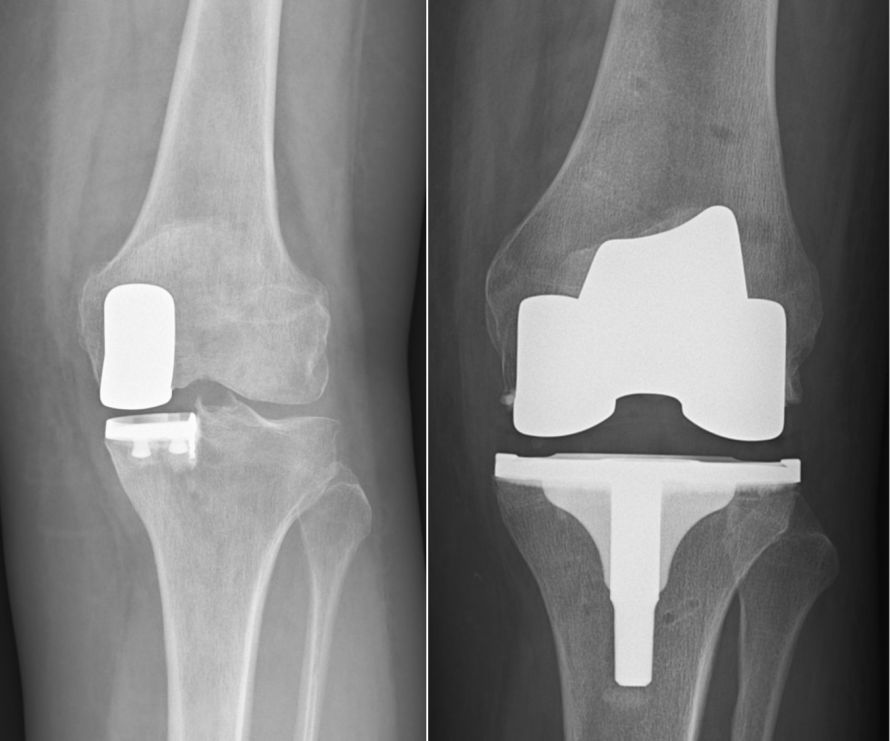
In an in-depth interview with Leading Medicine Guide, PD Dr. med. Philipp A. Michel, M.Sc. (Zentrum für Hüft- und Knieendoprothetik at ETHIANUM Heidelberg), shed light on this massive care gap. He emphasized that younger, active patients stand to benefit immensely from partial replacements, as they preserve the patient's own ligaments (including the ACL), offer a significantly higher "Forgotten Joint Score," and allow a much faster return to sports like golf, tennis, and skiing.
Comparison of X-ray images of a medial unicompartmental prosthesis (left) and a total prosthesis (right).
The Challenge: Millimeter-Scale Decisions depend on precise Diagnostics
Why is the partial knee replacement so heavily underutilized? According to Dr. Michel, it requires extreme surgical precision and a rigorous screening process. Misjudging the patient's anatomy or leg alignment by even a millimeter can lead to early implant failure.
To confidently identify who is a candidate for a partial replacement, surgeons need flawless, highly efficient pre-operative diagnostic workflows. And that is exactly where ImageBiopsy Lab comes into play.
In the Interview, Dr. Michel highlights how his team utilizes our AI technology to optimize their diagnostic pipeline:
During the examination, many patients report pain that mainly affects the medial compartment. For the final decision, special X-rays are also required: standing radiographs to measure the leg axis, stress radiographs to assess ligament stability, and further images showing the alignment of the kneecap. For an efficient evaluation, we rely on the AI analysis from the company ImageBiopsy Lab. Based on these criteria, it is checked step-by-step whether the patient is suitable for a partial replacement.
How IB Lab LAMA supports Surgeons
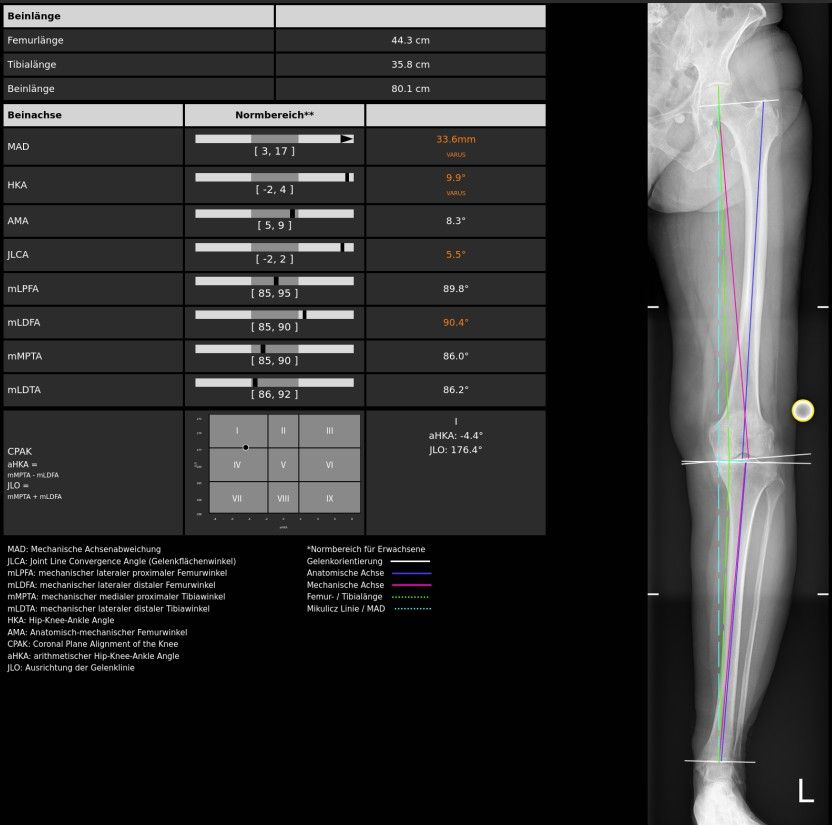
To confidently transition a patient from a total knee replacement to a joint-preserving partial implant, objective data is everything. This is precisely where IB Lab LAMA (Leg Alignment Module) becomes a critical asset in the clinical workflow. At the ETHIANUM Heidelberg, Dr. Michel and his team utilize this advanced AI module to automatically, objectively, and rapidly measure the mechanical axis of the leg on full-leg standing X-rays.
Instead of relying on manual, time-consuming, and sometimes subjective drafting on digital X-rays, the AI-driven assessment detects key anatomical landmarks and calculates deformities—such as varus (bow-legged) or valgus (knock-kneed) alignments within seconds.
By standardizing these complex radiological parameters, IB Lab LAMA provides a highly reliable foundation before the patient even enters the operating room. When this pre-operative AI precision is combined with advanced intraoperative robotic assistance like the CT-free CORI Surgical System the entire surgical team gains unprecedented control. The AI streamlines the diagnostic screening, while the robotics guide the physical execution.
Shifting the Paradigm: More Preservation, Less Replacement
The approach shared by Dr. Michel highlights a necessary shift in orthopedics: moving away from default total knee replacements toward a "preservation-first" mindset. Every patient deserves to be evaluated for a partial implant first, ensuring healthy bone, cartilage, and crucial ligaments remain completely untouched.
By integrating ImageBiopsy Lab’s AI-powered diagnostics in the radiology suite with cutting-edge robotics in the OR, pioneering surgeons are proving that partial knee arthroplasty is no longer a high-risk gamble. With objective data at their fingertips from day one, clinicians are finally equipped to bridge the care gap, making joint preservation safe, highly reproducible, and widely accessible.
Pfitzmann, A. (2026, April 30). Gelenkerhalt durch die robotisch assistierte Schlittenprothese - Moderne Endoprothetik am ETHIANUM in Heidelberg. Leading Medicine Guide / Leading Medicine Magazin. Interview with PD Dr. med. Philipp A. Michel, M.Sc.


.png)